


lesson 5 of Revelation: Four Ways To Understand Revelation:

lesson 5 of Revelation: Four Ways To Understand Revelation:lesson 5 of Revelation: Four Ways To Understand Revelation: FOUR WAYS TO UNDERSTAND REVELATION
Revelation is an exciting book of the Bible, where Jesus Christ is front and center as victor and King, offering hope and encouragement to Christians facing persecution. Yet with its apocalyptic visions and serious subject matter, it's often a misunderstood book of the Bible. Seeing the different approaches to Revelation, held by Christians throughout the centuries, will help bring understanding and insight.Commentary's
What are the four views of Revelation?
Both the Old and New Testaments reveal God as Lord over history. Christians of all eras have believed that Jesus will return a second time, but not all Christians have agreed that Revelation is about the second coming. Whether the visions in Revelation have been, are being, or have yet to be fulfilled is a matter of debate, but the spirit of the last chapter, calling on Jesus to come quickly, is something all Christians can agree upon—"Come, Lord Jesus!" (Rev. 22:20).
SUMMARY OF THE FOUR VIEWS OF REVELATION
FUTURIST
Revelation is a prophecy that is mostly about the end of the world.
IDEALIST
Revelation is a non-historical and non-prophetic drama about spiritual realities.
HISTORICIST
The book of Revelation is prophecy about church history from the time ofJohn to the end of the world.
PRETERIST
The book of Revelation is prophecy that was mostly fulfilled in the first century AD.
The Futurist View: According to the futurist view, all the events in Revelation are yet to occur. Revelation is mostly a road map for future--a prophecy about the end of the world and the years that come immediately before the end. Dispensational premillennialists as well as some historical premillennialists interpret Revelation in this way. The Futurist is, It will continue until the great tribulation when the Antichrist will temporality prevail. Christ in His second coming will triumph and usher in the final salvation of the faithful. The Historicist is, that it's happening now and will finally be completed when Christ returns. The Idealist is, it is what God has always been doing in the world--seeking and saving the lost. Christ will bring right when He returns. Last is the Preterist, It will continue as the gospel grows and spreads throughout the world. Jesus will finalize and renew all things when He comes.
The Historicist View: The Historicist view clams the Revelation is prophecy about church history from the time of John to the end of the world. Revelation is like a history textbook for present, and future. Historicists view the events in Revelation as symbolic descriptions of historical events throughout church history. Some futurists also understand the seven churches in a historic manner, treating each church as descriptive of a particular of church history.
The Idealist View: Idealists see Revelation as a non-historical and non-prophetic drama about spiritual realities. They believe it's a parable for all times and places and that the images, visions, and dreams are expressions of struggles between good and evil throughout time. This view seems to have started with ancient theologians in Alexandria, Egypt, who frequently spiritualizied biblical texts. This view also has followers today.
`
The Preterist View: Preterists understand the book of Revelation as a prophecy that was mostly fulfilled in the first century. To preterists, Revelation is like an ancient newspaper. Partial preterists view most of Revelation as prophecy fulfilled to the first century, through the final chapters describe future events that will occur at the end time. Full Preterists think that the retun of Jesus described in Revelation 19 was spiritual and occurred in AD 70. Preterists are typically amillennialists might fit in this category.


What are the views of the millennium?
Revelation 20, the only direct reference in the Bible to a reign of Christ that lasts one thousand u=years, is one of the most controversial section of the Bible. There are three basic views-premillennialism, amillennialism and postmillennialism--that help to categorize the different interpretations.
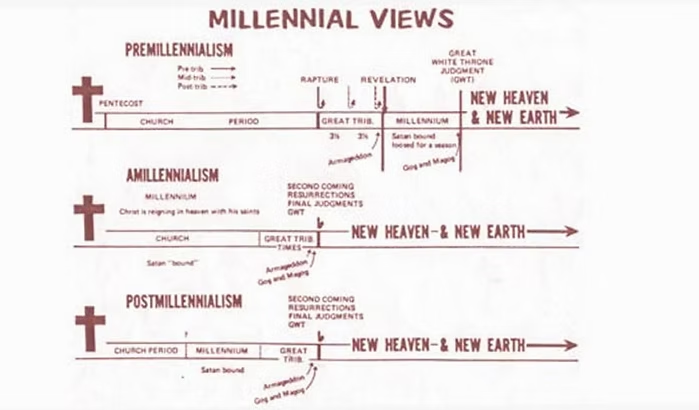
Premillennialism teaches that Christ will return before the millennium. Jesus will rule the world and begin an age of peace and security. There are two types of premillennialism: historical premillennialism and dispensational premillennialism.
Historical premillennialism is the belief that Christ will return at the end of the great tribulation. This time of tribulation may last seven years, or "seven," a biblical number that often symbolizes completeness, may refer to the completeness of tribulation. The church will go through this time if trouble but endure to greet Christ when He comes.
Dispensational premillennialism is the belief that the church will ot endure the great tribulation. Christ will remove the church from earth before that time, or at some point before the worst experiences of the tribulation.
Amillennialism is the belief that the millennium is not an actual period of one thousand years but the period now in progress, in which the gospel is spreading throughout the world and Christ is ruling at the right hand of God the Father.
Postmillennialism is the belieft that there will be a period of great peace and security when the gospel has spread throughout the world and Christ reigns spiritually, throughout His people. After this time of one thousand years or so, Christ will return to end history.


Comments